
Ping An Health (Ping An Good Doctor) — From Insurance Company to the World’s Leading FinTech and Integrated Healthcare Platform

This case study examines the business transformation journey of Ping An Health (formerly Ping An Good Doctor)—from its original mission of addressing congestion and inequality in China’s healthcare system to becoming the world’s largest integrated digital healthcare platform, serving more than 400 million registered users.
Readers will gain insight into how Ping An Health strategically deployed advanced artificial intelligence, including Generative AI, in close collaboration with human physicians to improve diagnostic accuracy, expand service capacity, and enhance healthcare delivery at scale. The case also distills key lessons from Ping An Health’s transition from a growth-driven model to a sustainable and profitable business, culminating in a successful return to profitability in 2025. This was achieved through the deliberate creation of a healthcare ecosystem that seamlessly integrates medical services, insurance, and corporate clients.
Background
Reinventing Healthcare Through “Internet + AI + Doctors”
Ping An Good Doctor—now rebranded as Ping An Health—is widely regarded as one of the most prominent global case studies in applying digital technology and artificial intelligence (AI) to transform the traditional healthcare industry.
Founded in 2014 by Ping An Insurance Group, the platform was created to address fundamental challenges in China’s healthcare system, particularly unequal access to medical services and overcrowding in public hospitals. From the outset, Ping An Health adopted the guiding principle of “Internet + AI + Doctors,” building a digital platform that connects patients, physicians, and hospitals into a single, coordinated ecosystem.
Scaling Impact with AI and Human Expertise
The success of Ping An Health’s transformation is reflected in its rapid and sustained growth. The platform has reached over 300 million users, covering nearly one-third of China’s internet population, and demonstrated exceptional resilience and scalability during the COVID-19 pandemic, when demand for remote medical services surged dramatically.
A key driver of this success has been Ping An Health’s investment in advanced AI capabilities, including “Ping An Xin Yi,” an AI Doctor Assistant, and medical large language models (LLMs). These systems achieve over 95% diagnostic support accuracy, significantly enhancing clinical efficiency while reducing the workload of physicians. Rather than replacing doctors, AI is used to handle repetitive, high-volume tasks such as symptom intake and preliminary triage, enabling medical professionals to focus on complex and high-risk cases.
From Growth to Profitability
Beyond technological innovation, Ping An Health has successfully navigated the critical transition from an early-stage, growth-oriented business to a sustainable and profitable operating model.
By integrating digital healthcare services with insurance-based managed care and enterprise health solutions, the company achieved a structural improvement in cost efficiency and revenue quality. This strategic shift enabled Ping An Health to record a net profit of RMB 134 million in the first half of 2025, marking a clear turning point in its financial performance.
Strategic and Societal Impact
The Ping An Health case demonstrates that AI Transformation can deliver tangible outcomes on two critical fronts:
Societal Value – Improving access to healthcare, reducing pressure on public hospitals, and supporting national objectives such as Healthy China 2030.
Business Value – Building a scalable, profitable platform through ecosystem integration, operational efficiency, and data-driven intelligence.
Ultimately, Ping An Health illustrates how AI-enabled transformation—when combined with domain expertise, system-level thinking, and disciplined business strategy—can simultaneously enhance public well-being and generate long-term economic value.
Business Overview

Ping An Good Doctor, founded in 2014, is the flagship HealthTech business of Ping An Insurance (Group) Company of China, Ltd., one of the world’s largest integrated financial services groups. The company was established with the vision of building a comprehensive healthcare ecosystem that seamlessly integrates financial services with healthcare delivery, in line with Ping An’s long-term strategy of“one customer, one account, multiple products, and integrated services.”
Ping An Good Doctor was listed on the Hong Kong Stock Exchange in 2018 (HKEX: 1833.HK), raising approximately USD 1.1 billion in its initial public offering. This marked one of the largest HealthTech IPOs globally at the time and reinforced Ping An’s strategic commitment to healthcare as a core pillar of its ecosystem.
Within the Ping An Group, the company—now rebranded as Ping An Health—plays a central leadership role in the Group’s healthcare and elderly care ecosystem. Its function extends beyond operating a standalone digital platform; Ping An Health acts as a catalyst that strengthens synergies across the Group’s insurance, financial, and healthcare businesses, enabling continuous improvement in medical services, preventive care, and long-term health management.

Business Model and Service Architecture
Ping An Health operates under an Online-to-Offline (O2O) model that integrates digital medical services with physical healthcare infrastructure. The model is built on three core components:
1. AI + Doctors Platform
Patients begin their healthcare journey with AI-assisted symptom screening through an AI Doctor, which performs initial triage and information gathering. Cases are then escalated to human physicians when appropriate.The platform is supported by a large and scalable medical workforce, including over 1,000 in-house physicians and more than 21,000 external partner doctors, providing 24/7 medical consultation services across a wide range of specialties.
2. Offline Healthcare Network
For cases requiring in-person diagnosis or treatment, patients are seamlessly referred to an extensive network of more than 3,700 partner hospitals across China.In addition, Ping An Health operates an online pharmacy and healthcare marketplace (Health Mall), offering prescription and over-the-counter medicines with home delivery within one hour in major cities, ensuring continuity of care beyond online consultations.
3. Target Customer Segments
Ping An Health serves three primary customer segments:
C-end (Consumers): Individual users seeking online medical consultations and long-term health management services.
B-end (Corporate Clients): Enterprises using employee health management, preventive care, and occupational health services.
F-end (Financial and Insurance Customers): Policyholders within the Ping An Group who receive integrated healthcare services as part of insurance and managed care offerings.
Revenue generation focuses primarily on annual membership-based services, such as Family Doctor programs, and corporate health screening and employee healthcare solutions, creating stable and recurring income streams.
Challenges

Ping An Health faced the challenge of strengthening its AI capabilities by combining large-scale medical data, advanced AI models, and real-world clinical deployment. In healthcare, AI leadership requires not only strong algorithms but also validated performance in real medical settings, where accuracy and trust are critical.
Structural Inefficiencies in China’s Healthcare System
Before digital transformation, China’s healthcare system suffered from severe overcrowding. Patients often waited three hours for a five-minute consultation, while medical resources were concentrated in major cities. Access to primary care was limited, placing heavy pressure on public hospitals.
Trust and Behavior Change (2014–2019)
In its early years, Ping An Health had to overcome patient skepticism toward online medical consultations. Building trust required significant investment in full-time physicians, clinical quality assurance, and positioning AI as a support tool rather than a replacement for doctors—raising operating costs during the growth phase.
Profitability and Cost Pressure
The company initially followed a “growth over profit” strategy, resulting in prolonged losses, including a net loss of RMB 734 million in 2019. High customer acquisition costs and medical staffing expenses led investors to question long-term profitability.
Scalability During COVID-19
During the COVID-19 outbreak, user demand increased by nearly tenfold within one month. The key challenge was maintaining system stability and clinical quality at scale, without overwhelming human doctors—highlighting the necessity of AI-enabled triage and automation.
Ping An Health originated from deep structural challenges in China’s healthcare system, where massive demand was met with a shortage of medical professionals and uneven resource distribution. Patients often waited long hours to see a doctor for only a brief consultation, making it difficult to shift consumer behavior and build trust in online medical services as an alternative to large hospitals. At the same time, the company faced a significant financial sustainability challenge, as its early business model prioritized rapid user growth over profitability. High costs associated with recruiting medical professionals and large-scale marketing led to prolonged operating losses. These pressures intensified during the COVID-19 crisis, when Ping An Health had to rapidly scale its platform to accommodate a tenfold surge in user demand, while maintaining high standards of speed, accuracy, and clinical triage under emergency conditions.
Goals and Outcomes

เป้าหมายของการทำ AI Transformation
Accessibility: ขยายการเข้าถึงบริการแพทย์สู่ทุกคน ลดความแออัดในโรงพยาบาล และเป็น "ประตูหน้าด่าน" ของระบบสุขภาพ
Integration: บูรณาการบริการออนไลน์และออฟไลน์ให้ไร้รอยต่อ (Closed-loop healthcare)
Sustainability: เปลี่ยนจากธุรกิจที่ขาดทุนเป็นธุรกิจที่มีกำไรยั่งยืนด้วยโมเดล Managed Care
ผลลัพธ์ที่ได้รับ (Outcomes)
เสริมศักยภาพ AI ด้วยข้อมูล + การทำฉลากข้อมูล
1.44 bn+ consultation records = มี “บันทึกการปรึกษาแพทย์/การซักถาม” สะสมมากกว่า 1.44 พันล้านรายการ → เป็นฐานข้อมูลจริงจากการใช้งานที่ใช้ฝึกโมเดล/ปรับปรุงคุณภาพการตอบของ AI
200.0 bn+ medical tokens = มี “โทเคนข้อมูลภาษา/ข้อความทางการแพทย์” มากกว่า 200 พันล้านโทเคน → โมเดลภาษา/ความรู้ทางการแพทย์ถูกฝึกด้วยข้อมูลระดับใหญ่มาก (เทียบได้กับวัตถุดิบสำหรับ LLM/AI)
มีแพทย์มากกว่า 500 คน ช่วย “ติดฉลากข้อมูลและให้ feedback” อย่างต่อเนื่อง → จุดนี้สำคัญมาก เพราะแปลว่า AI ไม่ได้เรียนรู้จากข้อมูลดิบอย่างเดียว แต่มีผู้เชี่ยวชาญช่วย “กำกับคุณภาพ” ลดความผิดพลาด/หลอนข้อมูล (hallucination)
AI ทำให้แพทย์ดูแลผู้ป่วยได้มากขึ้นและแม่นยำขึ้น
แพทย์สามารถรองรับได้ เมื่อมี AI ช่วย ประมาณ 4 ล้าน เคส/คำขอต่อวัน → AI ช่วยขยาย capacity ของระบบบริการแพทย์อย่างมาก
ความแม่นยำของการซักถาม/ให้คำปรึกษาที่มี AI ช่วย อยู่ราว 98% → ตอกย้ำว่า AI ถูกใช้เป็น “ผู้ช่วยงานคลินิก” (เช่น ซักประวัติ คัดกรอง สรุปเคส) ด้วยความแม่นยำสูง
ความแม่นยำเกือบ 80% สำหรับการช่วยสนับสนุนการดูแลผู้ป่วยอาการหนักในรูปแบบ MDT (Multidisciplinary Team: ทีมสหสาขา) → AI ช่วยในงานที่ซับซ้อนระดับ “ผู้ป่วยวิกฤต/โรคซับซ้อน” โดยสนับสนุนการตัดสินใจของทีมแพทย์หลายสาขา
ความเป็นผู้นำด้านนวัตกรรม AI: ความสำเร็จในการพัฒนา Ping An Xin Yi (AI Doctor Assistant) และโมเดล Large Language Model (LLM) ทางการแพทย์ ที่มีความแม่นยำในการคัดกรองอาการ (Triage) >99% และช่วยวินิจฉัยโรค >95%
AI เข้ามาช่วยงานซ้ำซ้อน ทำให้แพทย์สามารถดูแลคนไข้จำนวนมากได้อย่างมีประสิทธิภาพ
ลดต้นทุน + เพิ่มประสิทธิภาพงานหลังบ้าน
AI ช่วยลด “ต้นทุนเฉลี่ยต่อผู้รับบริการ” ของบริการ Family Doctor ลงประมาณ 52% เมื่อเทียบกับปีก่อน (YoY) → AI ทำให้ต้นทุนการให้บริการต่อหัวลดลงมาก (เช่น ลดเวลางานแพทย์/เจ้าหน้าที่ต่อเคส เพิ่มการทำงานอัตโนมัติ)
AI ช่วยเพิ่ม “ประสิทธิภาพการทำงานของ middle office” (งานสนับสนุน/หลังบ้าน เช่น งานเอกสาร เคสเมเนจเมนต์ การประสานงาน การเคลม ฯลฯ) ประมาณ 50% YoY → AI ไม่ได้อยู่แค่หน้าบ้าน (ปรึกษาแพทย์) แต่ยกระดับกระบวนการปฏิบัติการทั้งองค์กร
ผลประกอบการทางการเงิน (Financial Turnaround):
พลิกฟื้นจากขาดทุนสู่กำไรสุทธิอย่างเป็นรูปธรรมในช่วงกลางทศวรรษ 2020 (กำไร 134 ล้านหยวนในครึ่งแรกปี 2025)
รายได้จากบริการทางการแพทย์เติบโตสูง และมีฐานลูกค้าที่ชำระเงิน (Paying Users) เพิ่มขึ้นเป็นกว่า 32 ล้านคน
ผลกระทบเชิงสังคมและขนาดธุรกิจ:
มีผู้ลงทะเบียนใช้งานสะสมมากกว่า 400 ล้านคน เป็นแพลตฟอร์ม Telemedicine ที่ใหญ่ที่สุดในโลก
ช่วยลดภาระโรงพยาบาลรัฐในช่วงวิกฤต และได้รับการยอมรับจากภาครัฐให้เชื่อมต่อกับระบบประกันสุขภาพแห่งชาติ
ขยายบริการสู่ภาคองค์กร (B-end) ครอบคลุมพนักงานบริษัทกว่า 26 ล้านคน
การนำเทคโนโลยีมาขยายโอกาสการเข้าถึงบริการสาธารณสุข (Accessibility) เพื่อแก้ปัญหาความแออัดของโรงพยาบาลในจีน ควบคู่ไปกับการสร้างโมเดลธุรกิจที่ยั่งยืนด้วยการเชื่อมโยงระบบนิเวศออนไลน์-ออฟไลน์และประกันภัยเข้าด้วยกัน ผลลัพธ์ที่เกิดขึ้นคือความสำเร็จในการสร้างแพลตฟอร์มการแพทย์ดิจิทัลที่ใหญ่ที่สุดในโลกด้วยฐานผู้ใช้งานสะสมกว่า 400 ล้านคน และการพัฒนานวัตกรรม AI "Ping An Xin Yi" ที่มีความแม่นยำในการช่วยวินิจฉัยสูงกว่า 95% ซึ่งช่วยยกระดับประสิทธิภาพการรักษาได้อย่างเป็นรูปธรรม นอกจากนี้ บริษัทยังบรรลุเป้าหมายทางการเงินโดยสามารถพลิกฟื้นจากภาวะขาดทุนมาสู่การทำกำไรสุทธิได้สำเร็จในปี 2025 ผ่านกลยุทธ์ Managed Care ที่เจาะกลุ่มลูกค้าองค์กรและประกันภัย สะท้อนถึงชัยชนะทั้งในมิติทางสังคมและธุรกิจ
Part 1: AI TRANSFORMATION READINESS
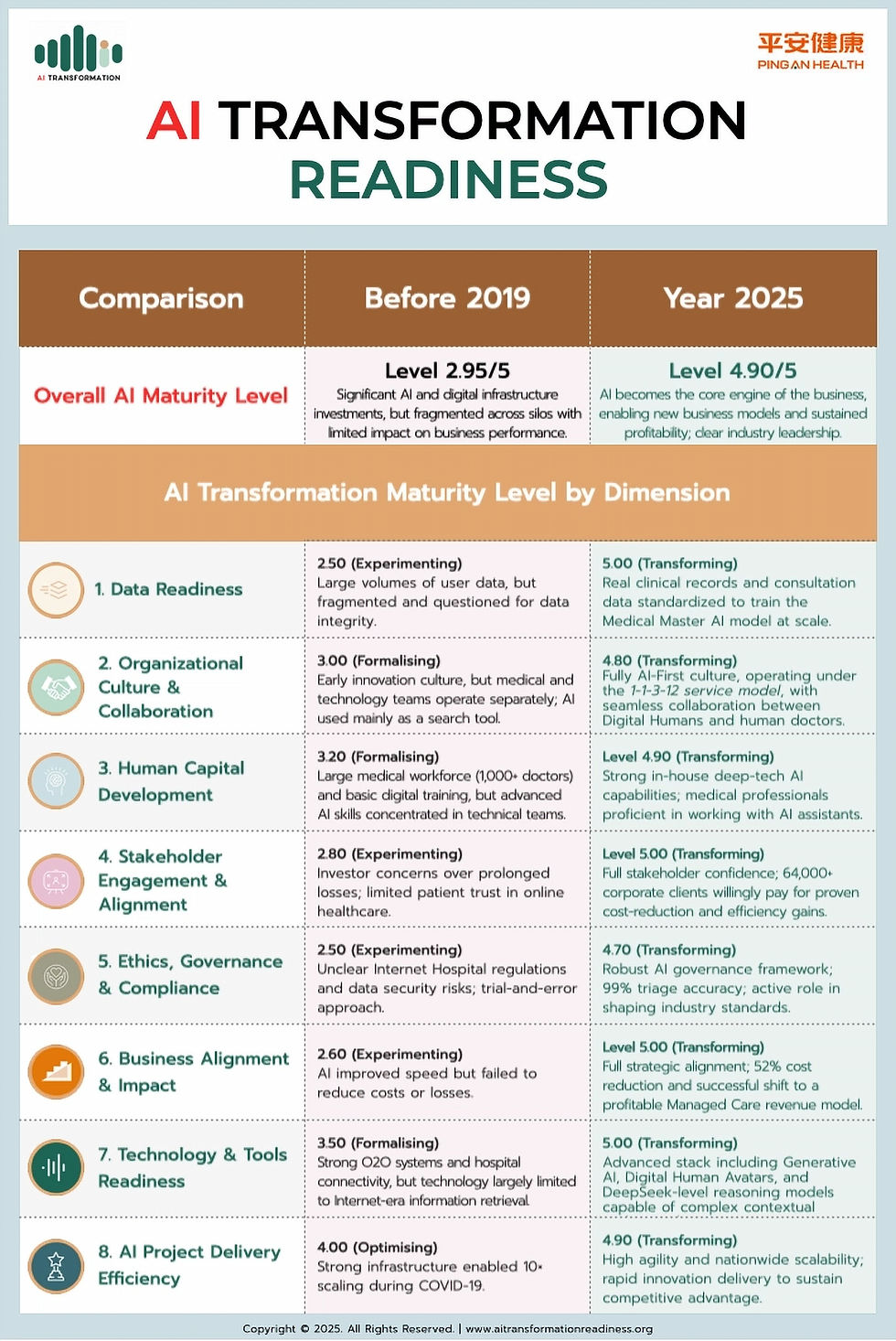
This analysis compares Ping An Health’s AI Transformation Readiness across two key periods: before full transformation (2014–2019), when growth in user numbers was the primary focus, and after transformation (2024–2025), when the company shifted toward Managed Care and Generative AI to achieve sustainable profitability.
AI Transformation Readiness Assessment: Before and After
The assessment of AI Transformation Readiness before and after the transformation highlights the following progress:
Part 2: AI TRANSFORMATION CANVAS
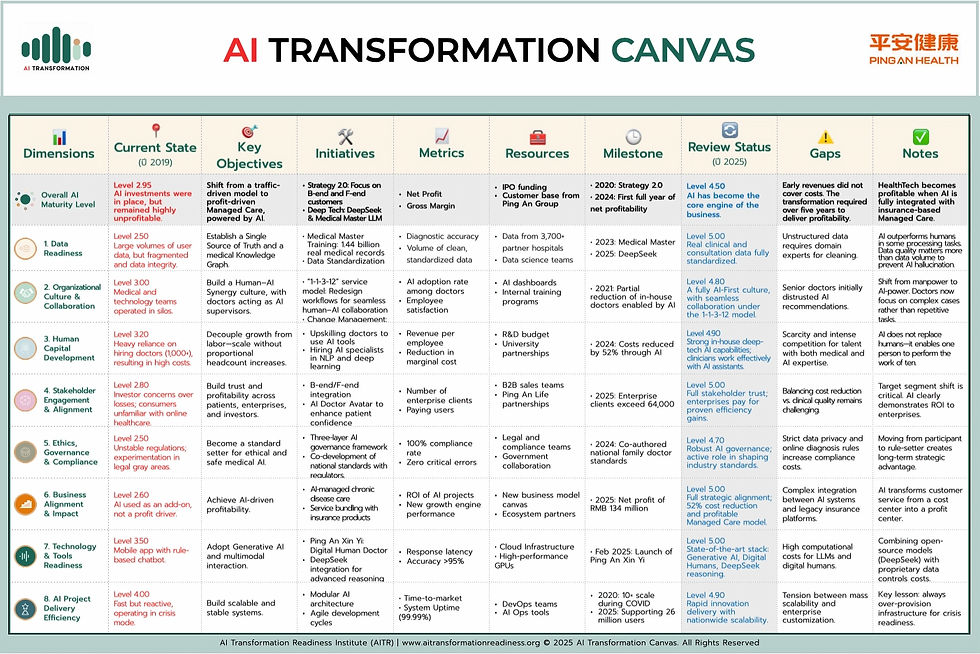
Before 2019, Ping An Health operated at AI Transformation Readiness Level 3: Formalising. The company had invested in early AI systems and established digital infrastructure, but AI was mainly used to support operations rather than to drive the core business model. The connection between AI and financial performance remained weak, and the company continued to incur significant losses.
By 2024–2025, Ping An Health had advanced to Level 5: Transforming. AI became the core engine of the business, enabling new revenue models such as 24/7 AI Doctor services powered by Generative AI and Digital Human technologies. These capabilities significantly improved service scalability, reduced labor dependency, and supported the company’s return to profitability.
Ping An Health’s transformation demonstrates how organizations can move from technology adoption to true differentiation by redesigning their business models. By shifting from traffic-driven growth to value-based managed care and embedding Generative AI at the core of operations, the company successfully decoupled growth from human labor costs, turning structural cost pressures into sustainable competitive advantage.
Are You Ready to Build Sustainable Strategic Advantage for Your Organization?
Unlock future growth, lead AI transformation with confidence, and accelerate measurable impact—starting today.
🚀 Accelerate: AI Transformation & Business Plan Develop a comprehensive, AI-driven transformation and execution plan that aligns strategy, operations, and technology—designed to turn AI ambition into tangible business results.
List of References
Fisk, P. (2019, September 23). Ping An Healthcare’s “Good Doctor” now has over 300 million users … the world’s leading online healthcare ecosystem platform. Peter Fisk.
Healthcare Asia. (2021). Ping An Good Doctor's revenue rose 35.5% to $1.06b in 2020. Healthcare Asia Magazine.
Kim, W. C., Mauborgne, R., & Ji, M. (2023). Ping An Good Doctor: Creating a nondisruptive solution for China’s healthcare system. Blue Ocean Strategy.
Ping An Healthcare and Technology Co., Ltd. (2021, August 24). Ping An Good Doctor posts 39% revenue growth in the first half of 2021, total number of registered users reaches 400 million. PR Newswire.
Ping An Healthcare and Technology Co., Ltd. (2024). Ping An Health reports first full-year profit in 2024. Ping An Health.
Ping An Healthcare and Technology Co., Ltd. (2025, February 26). Ping An Health launches “Ping An Xin Yi” AI Doctor Assistant service to enhance accessibility and satisfaction in medical services. Thailand Business News.
Ping An Healthcare and Technology Co., Ltd. (2025, August 19). Ping An Good Doctor (1833.HK) reports strong interim results: Revenue and profit accelerate as AI fuels new growth momentum. PR Newswire.
Ping An Insurance (Group) Company of China, Ltd. (2021). Bridges to health for China’s people. Ping An Group.
Ping An Insurance (Group) Company of China, Ltd. (2024, November 7). Ping An takes lead in Fortune Fintech Innovator Asia list, ranked 1st in insurtech. PR Newswire.
Reuters. (2018, April 26). Ping An's Good Doctor unit raises $1.1 billion in Hong Kong IPO. Reuters.
Yang, Q. (2020, May 18). China’s Ping An Good Doctor tanks after ousting founder chairman. Yicai Global.


